A surprising trend has emerged in the New Zealand property market where, in many cases, homes with higher flood exposure are recording stronger value growth than properties with little or no flood risk. Cotality warns buyers that insurance is a non-negotiable prerequisite for mortgage lending and any future retreat by insurers means no loan and no liquidity.
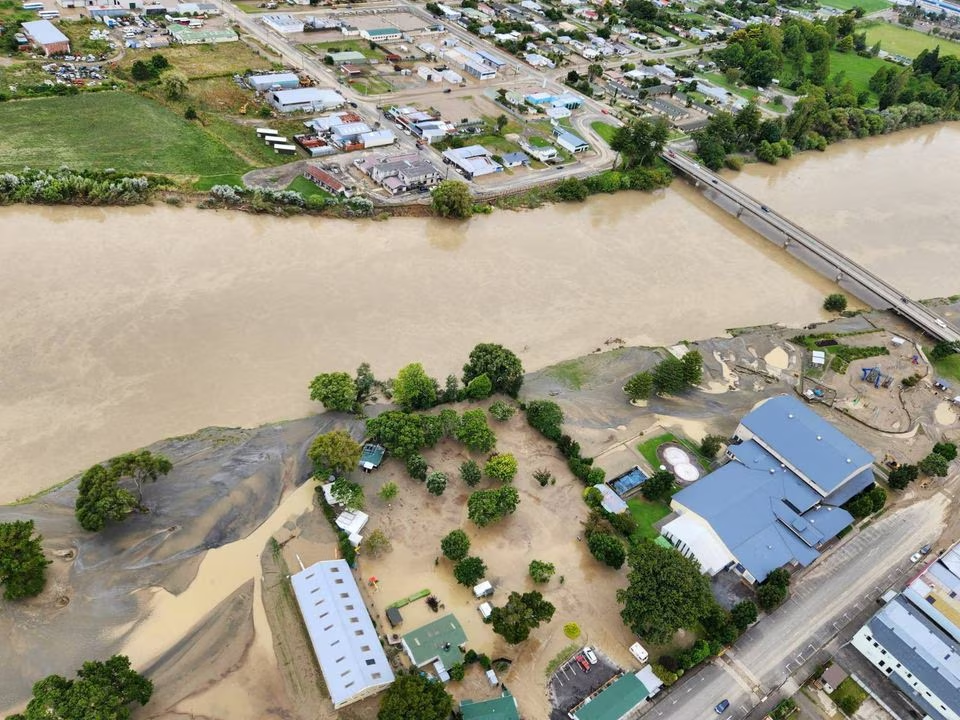 A flood of investors is chasing discounted danger-zone properties. New analysis from Cotality has revealed a striking affordability paradox within New Zealand’s housing market.
Despite a recent and unprecedented surge in the severity and cost of extreme weather events, buyers are increasingly overlooking long-term flood hazards in favour of lower entry prices, causing flood-affected properties to outgrow the broader market in value.
The research utilises Cotality’s advanced property-level pricing model, customised with granular flood-extent flags and 500-metre buffer rings to isolate the precise impact of climate hazards on property values.
Cotality New Zealand Chief Data Officer Craig Dargusch explained that while buyers face undeniable climate risk, immediate financial pressures are dictating purchase decisions.
“Our data shows that flood-affected properties trade at an initial discount, but the market is buying them anyway and growing their value faster than the rest,” Dargusch says.
“Buyers are actively accepting known flood exposure in exchange for a lower price point, which inadvertently accelerates the rate of value growth in these vulnerable zones.”
Auckland vs Hawke’s Bay
In Auckland, where the median dwelling value sits at $1.05M, purchasing a home in a flood-susceptible pocket of a suburb like Mount Albert offers an upfront discount of $70k to $100k.
This price variance has driven more intense demand among budget-conscious buyers.
Consequently, cumulative house value growth in Auckland’s impacted zones reached 18.4 percent since 2020, leaving nearby comparable buffer zones behind at 13 percent.
A similar pattern emerged in Hawke’s Bay following Cyclone Gabrielle. While the disaster generated a devastating $14.5 billion economic impact and displaced more than 10,000 people nationally, the local shock was heavily felt in the regional property market, triggering a 10 percent to 15 percent median rent spike in Hawke’s Bay due to a sharp 30 percent contraction in local rental listings.
Post-Gabrielle, impacted properties in Hawke’s Bay outperformed surrounding areas by up to five percentage points. While that gap has since narrowed, impacted zones retain a higher cumulative growth rate since 2020 at 24.3 percent, compared to 22.7 percent for properties situated within a 500-metre buffer ring.
Dargusch notes that smaller regional markets demonstrate a slightly less pronounced divergence than metro areas.
“With median values in Napier and Hastings sitting well below Auckland at $703k and $710k respectively, buyers have a different starting point,” Dargusch says.
“Furthermore, in a tighter-knit regional market, local buyers often possess sharper, localised knowledge of exactly which streets flood, allowing them to price risk more precisely.”
National trends
Nationally, the trend remains highly consistent, displaying the sharpest divergence at the geographical and statistical extremes.
Properties designated with a Cotality FloodScore of 5 (Very High risk) recorded a 26.1 percent increase in total growth change since January 2020. Conversely, properties classified with a score of 0 (No risk) saw total growth of a more modest 19.8 percent over the same period.
Caveat emptor
Cotality warns that this divergence in long-term growth faces an impending friction point as insurance providers refine their property-by-property asset risk profiling.
“While the consumer market is currently absorbing these properties, the credit lens is evolving rapidly,” Dargusch says.
“Insurance availability is becoming the de facto pricing mechanism for climate risk at the property level. Because insurance is a non-negotiable prerequisite for mortgage lending, any future retreat by insurers means no loan and no liquidity.”
“Lenders inherit what insurers leave behind, leading to uncollateralised exposure if an industry-wide cliff edge is not avoided through collaboration and cross-sector alignment. Affordability wins today, but risk shapes tomorrow.”